Week Ten: Negotiating rupture and ways of life

Heading into the 1992 Earth Summit, or United Nations Conference on Environment and Development, in Rio de Janeiro, then-U.S. President George Bush made clear, “the American way of life is not up for negotiation.” The following year, in a published chapter entitled, “Global ecology and the shadow of ‘development,'” Wolfgang Sachs argued Bush’s statement effectively yoked the right of countries to maintain their rates of economic and industrial development and expansion to the interests of maintaining the environment. He argued, further, keeping development as a core principle at Rio enabled international cooperation among a range of international actors, however, “it prevents the rupture required to head off the multifaceted dangers for the future of mankind” (Sachs, 1993, p. 3).

Heading into the last two weeks of Canada’s federal election, this word — rupture — is one I can’t help returning to. Have we had the honest-to-goodness rupture moment in this election? The moment when all the potential sacrifices, real-life impacts of climate strategies, and carbon taxes have been laid out before us, to judge and to weigh? Between media coverage and party platforms (as well as party advertisements), have voters seen all the options and all the plans? At times, it has seemed that, between troubling distractions and speeches emphasizing how the ways of life of middle class voters will be maintained and made better, discussion of serious change couldn’t be farther from this election.

Yet, rather serious people — people like former Bank of Canada Governor and current Bank of England Governor Mark Carney — talk openly about rather massive changes that need to be made, including, as the Globe reported from a speech Carney gave in London last week, “pricing in the risk of moving to a low-carbon future.” Soon after the Oct. 19 vote, Canada’s government will be expected to represent the country at Paris climate talks for a universal climate agreement, and the prime minister will have to engage with the notion of a “postpetroleum world.”

Meanwhile, according to a memo leaked last week, officials within Canada’s Department of Foreign Affairs are looking for the post-Oct. 19 government to take up a more serious international role on climate change:

The memo recommends that the Department of Foreign Affairs, Trade and Development take a more active role in promoting climate change engagement by targeting programs at climate finance, clean technology and “climate-smart agriculture.”

“While the ultimate responsibility for multilateral engagement on climate change rests with Environment Canada, DFATD could encourage the new government to earmark resources for this purpose,” the memo says.

Cited work & recommended readings

Sachs, W. (1993). Global ecology and the shadow of ‘development.’ In W. Sachs (Ed.), Global Ecology: A New Arena of Political Conflict, pp. 3-21. London & New Jersey: Zed Books

McKibben, B. (2000). We’re all environmentalists now, right? Round one. The Atlantic. http://www.theatlantic.com/past/docs/unbound/roundtable/environment/mckibben1.htm

Vidal, J. (2012). Rio +20: Earth summit dawns with stormier clouds than in 1992. The Guardian. http://www.theguardian.com/environment/2012/jun/19/rio-20-earth-summit-1992-2012

New resources

Equiterre and Environmental Defence released a 16-page analysis of how the parties might tackle climate change last week, while the Anglican Church discusses “caring for creation” in its report, An Anglican Approach to Election 2015. (If anyone out there has seen similar resources from other religious groups, please send me a note!)

Other environmental news
Finally, speaking of politics and the Keystone XL

Week Nine: Canada’s place in the world

If the environment is your key election issue, perhaps one of the most disheartening, repetitive elements of media coverage through August and September has been the consistent look at oil, pipelines, climate change, and conservation through the lens of a slow economy. With one set of issues tied, always, to the other, it is difficult to discuss seriously the notion of doing anything that could further slow the economy. Yet to seriously (hope to) turn things around on the environment, isn’t such a discussion necessary?

On this down-beat, I start this week with an offering of pieces that reflect upon Canada’s place in the world:

Even if the environment is not your issue, Mark MacKinnon’s analysis for the Globe and Mail, “Harper’s world: Canada’s new role on the global stage,” is a must-read. If the environment is your issue, this is a place to pause:

Environmentalists remain […] in shock over Canada’s 2011 decision to withdraw from the 1997 Kyoto Protocol on curbing greenhouse-gas emissions. The Canada that brought the world together in 1987 to sign the Montreal Protocol to combat ozone-depleting substances seemed to have changed almost unrecognizably.

Going into this week’s leaders’ debate, global environmental politics professor Dr. Peter Stoett offers this primer, which includes this take on the importance of discussing climate change:

Climate change should be foremost in any discussion of foreign policy. Canada has not only flouted the global trend toward serious action on climate change, but has also pulled out of an inexpensive convention on desertification and has not been the leader it could be in promoting sustainable development with alternative energy technology. [….]

I hope the leaders will make bold commitments to reduce greenhouse emissions and move away from the energy superpower rhetoric that contributes to the diminishment of Canada’s reputation among those who will be most vulnerable to the impacts of climate change and reduces our buoyant, multi-dimensional economy to a resource-based dependency.

I would also like to see discussion of other issues related to the environment: the United Nations’ sustainable development goals, the oceans, responsible Canadian investments abroad and conserving biodiversity worldwide. But I doubt we will get there.

Further on climate change, Germany’s ambassador has said Canada is needed as a strong climate ally this fall in Paris, and Hillary Clinton envisions Canada, the United States, and Mexico working as a team on a new climate strategy. Clinton also swept headlines last week with her (long awaited) voiced opposition to the Keystone XL pipeline that would carry bitumen from Alberta to the Gulf Coast — her opposition has ramifications for Canada’s election, though after reading this piece from the UK-based Guardian, it’s difficult to gauge the actual impact of her announcement.

More on oil & politics in Quebec

The French-language debate last week offered insight into how oil politics play in Quebec, and this excerpt from a CBC story offers a neat, if distractingly leader-centered summary:

Bloc Québécois Leader Gilles Duceppe pressed the NDP leader, who goes by Tom in English but Thomas in French, on his views on oilsands.

The BQ leader cited comments that Mulcair had made in French and in English on the topic, suggesting they were contradictory.

“I’d like to know if Tom talks to Thomas from time to time,” quipped Duceppe.

More interesting, however, is an exchange regarding exporting water.

Other headlines this week

Week Eight: “What comes next?”

Watching last week’s Globe and Mail leadership debate, entitled, “Our economy. Our future,” a question that stood out, from an environmental perspective, is this from the Globe‘s editor-in-chief to Stephen Harper:

Your dream, though, of being an energy superpower [has] not been realized. For those who are worried about jobs of the future, what comes next?”

As is evident from the premise — drawing upon Harper’s near-decade of international and domestic speeches emphasizing Canada’s natural resource extraction and export economy — this is a question about what comes after an oil-centered economy.

Listen to Harper’s response, at 20:15:

The answer would seem to stand out far less than the question, or at least to be less preoccupied by the future than by the past. Much later in the debate, Harper similarly stuck to discussion of his government’s long-term plan, which can be understood as continuing to hold resource extraction and trade at its core.

This is, perhaps, the problem with accepting the election frame Harper and the Conservative Party offered on Day 1: the key issue of this election is the economy and the Harper government’s economic record. Does accepting and elaborating upon this framing allow other issues, like the environment, to be sidelined?

(For a different example of the environment being sidelined, see this series of CBC interviews with the Conservative, Liberal, and New Democrat party leaders.)

Of course, if you do have the time to watch the Globe debate in its entirety, spend some time with the context offered by Kelly Cryderman at the start — Cryderman highlights how the economy and questions of the economy are important for people in Alberta who are experiencing “sleepless nights,” who are worried about their mortgages, their jobs, and their personal debt loads. Is this kind of intensely personal context missing from the environmental debate in this election? Making connections to people’s bank accounts and potential sacrifices was certainly missing from the later debate discussion of both the NDP’s and Liberal party’s plans for capping, trading, and/or pricing carbon should they be elected.

More debate coverage

Other climate change news

Other pipeline news

More on the candidates

Week Seven: On oil

If you only read three stories this week to consider the importance and role of oil in this election — and to consider the case for thinking outside of pipelines and extraction as leading economic drivers — here are my strong recommendations:

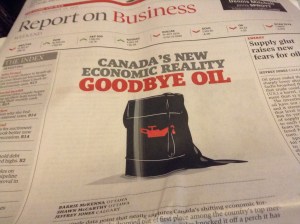
  1. If you haven’t already, go find this weekend’s copy of the Globe and Mail. Largely structured around the question of what comes after oil, its Business and Focus section are dedicated to unpacking “Canada’s new economic reality,” and still more promisingly, offering potential solutions for significantly diversifying the national economy. Mushroom harvesting? “More female geeks”? More wind power? So much to talk about!

    2015-09-14 11.05.06

  2. Also from the Globe, Margaret Atwood’s piece, “Can Canadian oil green-clean itself?” Breaking open the problems Canadian oil faces, Atwood critiques the prime minister’s performance in this area to date, questioning as well whether Stephen Harper has been the ally the oil industry has needed:

    “If you were a leader promoting Canadian oil, maybe you should avoid annoying every other leader whose co-operation or territory is needed for your favoured projects – such as pipelines – to go ahead. Instead, Mr. Harper has threatened the U.S. President, treated First Nations with contempt, gone out of his way to antagonize the Premier of Ontario, and sullied Canada’s reputation abroad through foot-dragging over carbon-reduction treaties.

    “The oil patch must be wondering whether they backed the right champion. A leader able to admit to the CO2 problem, support practical tech, and avoid demonizing other points of view would be a wiser choice.”

  3. In the National Post, Max Fawcett outlines what a “mature conversation” about the oil sands might entail right now. In service of the argument, there may be one too many rhetorical uses of “apparently” here, and too easy a slide between the idea of leaving some oil in the ground and turning entirely from oil development. But the argument itself deserves thorough examination in the weeks ahead:

“The real solution lies in reducing the demand for oil and refined products, and the single best way to achieve that is through the implementation of a carbon tax. After all, the bulk of emissions take place at the tailpipe, not the wellhead. Given that, punishing a particular source of supply when dozens of other ones are available is more about political posturing than actually reducing emissions.

“That’s why I have a hard time taking calls for a “mature conversation” about the oil sands seriously. Mature conversations, after all, don’t trade in intellectual binaries and moral absolutes, and they aren’t conducted using internet memes and snappy tweets.”

Headlines

The headline for this New Republic story — “Stephen Harper Turned Canada into a Climate Villain. An Election Won’t Change That” — doesn’t hold anything back. But if the headline reads as tough criticism of the prime minister, the analysis shows all of the political parties are either setting their targets on carbon emission cuts too low, or aren’t being specific enough about how they will make change.

Week Six: Bill Nye visits the oil sands and other long weekend-ish news

Bill Nye, who taught a generation (my generation) about science via a series of VHS tapes played in schoolrooms across the land, was in northern Alberta last week working on a show that will feature the oil sands. As APTN reports, the scale of bitumen development had an impact on Nye, who also noted the upcoming federal election could bring about helpful change. Drawing on their own archives and the APTN interview, Vice notes Nye has previously called Conservative leader and prime minister Stephen Harper a “controversial” figure when it comes to climate change:

Nye, who is also CEO of the Planetary Society, has been speaking out about climate change for years. Last year in an interview with VICE, he was already talking about Harper’s focus on fossil fuels and how it’s hurting Canada.

“The government in Canada is currently being influenced by the fossil-fuel industry,” Nye told VICE. “Stephen Harper is a controversial guy in the science community because [of] the policies, especially in Western Canada.”

Nye’s visit carries little weight in a sea of election news, but is relevant for its ability to draw attention to oil sands development, the communities of First Peoples in and around the region, and to remind Canadians that people outside the country are watching and wondering what will happen as a result of this election, particularly on Canada’s climate change response agenda.

Following the leaders

This Huffington Post story about new NDP ads featuring leader Thomas Mulcair highlights the absence of environmental issues from the party’s English-language push. Both the party’s French and English videos feature windmills, but whereas protecting the environment is explicitly part of Mulcair’s agenda as presented to Quebec, in the English video (below), Mulcair is identified as having been Quebec’s environment minister in a visual clip. In his voiceover, he simply says, “As a cabinet minister, I brought people together to get things done and make a difference in people’s lives. We need to give our kids a better start in life, ensure our young people get the opportunities they need and our seniors get the benefits they deserve…”

It would be interesting to know what the NDP knows about voters’ interests in Quebec versus the rest of Canada; why does one audience get passing reference to the environment and social justice (and many references to Stephen Harper), while the other primarily receives coded references to the economy?

This said, the NDP made clear last week it plans to put legislation to work that would significantly reduce greenhouse gas emissions if elected. There is more news to come before Oct. 19, according to the party’s environment critic, but this story offers an outline of the party’s plans should it have the opportunity to define Canada’s contributions to international climate change discussions in Paris later this year. Compare this to incumbent Conservative minister Lisa Raitt, who, according to a story in the National Observer, left future discussions about how the Tories would handle the Paris conference to the prime minister. To date, and as recently as in the past week, Canada’s response to climate change has been characterized as “inadequate.”

In an interview in Quebec last week, Green Party leader Elizabeth May is recorded as having spoken very little about her party’s environmental agenda, but the Montreal Gazette Q&A does take up May’s explicit opposition to the Energy East pipeline.

Despite so many reports of how tightly controlled Stephen Harper‘s campaign events are, a Nipissing Township, Ont. man managed to get up close and personal, and get his photograph taken beside Harper while wearing an anti-Energy East T-shirt.

An Abacus poll Maclean’s reported on last week highlights how warmly respondents felt about Thomas Mulcair and Justin Trudeau, while carving a hard line between perceptions of abilities to care for young people or be good company versus abilities to persuade or negotiate.

Other news

Week Five: Pulling back focus

If we accept the popular expectation that the “real” federal election starts next week after Labour Day, for this week it is interesting to pull focus back somewhat, from what has been covered environment-wise on the election trail (pipelines, spending on infrastructure) to what has been taken up by media outside election coverage.

These items contribute to how we might think about climate change and living in our environment, yet for the most part they occupy a non-election space, not technically anchored by the daily doings of Stephen Harper, Elizabeth May, Thomas Mulcair, Justin Trudeau, or their parties, but no less influential upon our lives and the state of federal governance post-Oct. 19.

North

This week Barack Obama is in Alaska for the Conference on Global Leadership in the Arctic. As this Globe story outlines, whereas other countries are sending their environment ministers, Canada is sending a bureaucrat, which can be read as a symbolic failure to buy in on “immediate action” to safe-guard the region, or at best a distancing of members of the current federal government from whatever decisions are made or discussions had.

Foreign ministers from five of the seven circumpolar nations – Denmark, Finland, Iceland, Norway and Sweden, all of which are expected to back Mr. Obama’s call for immediate action to cut emissions and protect the Arctic – will attend the Conference on Global Leadership in the Arctic: Cooperation, Innovation, Engagement and Resilience (GLACIER).

Only two countries – Canada and Russia, where resource exploitation, not curbing carbon emissions, is the top Arctic priority – won’t send a minister to hear Mr. Obama’s call for action.

Neither Foreign Minister Rob Nicholson nor Environment Minister Leona Aglukkaq, who led the Arctic Council during Canada’s two-year chairmanship, will attend the two-day GLACIER conference hosted by U.S. Secretary of State John Kerry in Anchorage, Alaska. Instead Ottawa is sending a senior bureaucrat, Daniel Jean, a deputy minister. Moscow will be similarly represented by an official, Russia’s U.S. Ambassador Sergey Kislyak.

This is no peripheral issue. Arctic energy extraction and sovereignty, the potential for having to move isolated and remote communities to safer ground in the years ahead, and other ramifications and results of climate change need to be dealt with. One might take issue with the U.S. government’s showcasing of “climate impacts in the Arctic as a harbinger for the world”–something like showcasing canaries in coal mines, which undermines the agency of people who live in the region now–but the political task at hand isn’t really shelve-able.

Related

West

Media coverage of the Unist’ot’en Camp on the weekend highlighted two omissions from serious political debate or elaboration since the election was called: the ramifications of Bill C-51, and what happens if First Nations communities say no to proposed energy pipelines. This CBC story published Friday highlights concerns that the RCMP would use the new law to carry out mass arrests, seriously hindering the camp’s ability to bar entrance to unceded traditional territories by energy company surveyors and workers. The B.C. Civil Liberties Association issued its opposition to the potential move on the weekend, and Green Party Leader Elizabeth May joined a list of prominent people and organizations offering their support to Unist’ot’en. For its part, the RCMP released official word that it had no such plans:

The BC RCMP respects the rights of individuals to peacefully protest says Cpl. Janelle Shoihet, on behalf of North District RCMP. To clarify, the BC RCMP has no intention of ‘taking down the camp’ set up by the Unist’ot’en. We value the Wet’suwet’en culture, the connection to the land and traditions being taught and passed on at the camp, and the importance of the camp to healing.

Among a cross-section of resources to continue monitoring this story, this journalist’s Twitter feed is particularly useful.

Related

Energy notes

Alberta is beginning serious work on refining its approach to energy royalties/provincial revenues with a new panel and a reach-out to Albertans.

For those interested in engaging questions of what comes after oil, however, check out video from this Petrocultures panel that took place in Edmonton and linked media coverage.

In this interview with Saskatchewan Premier Brad Wall, the absence of carbon capture from the election agenda is queried.

Global News offers in-depth analysis of “what you need to know about oilsands and the 2015 election.”

This year’s multi-element Atkinson Series is focused on the oil sands and “examining the costs of Canada’s oil sands bargain.”

South

East

Week Four: Paddles, canoes and pipelines

The week in environmental coverage of the federal election brings us back to two key questions: First, what might thinking through and explicitly naming “sacrifices” lend to a discussion of balancing the environment and the economy? Second, how are pipeline politics being discussed by different regional, national, and international constituency groups?

Environment v. economy

In the name of protecting B.C. salmon last week, Stephen Harper pledged $15-million toward habitat conservation and signaled plans to partner with the Pacific Salmon Foundation. Here is the partial announcement on the Conservative party’s web site. The final paragraph on the Tory web site–“Our conservation record shows that you can protect our cherished natural environment while still growing the economy”–looks familiar four weeks into the campaign, as all the major parties have noted the economy won’t be sacrificed for environmental management and the environment won’t be sacrificed for economic development.

Last week Justin Trudeau promised a Liberal government would spend $200-million a year developing clean technologies across a number of industries, as well as money for companies to market their new clean products. Making the announcement, Trudeau said, “The environment and the economy go together like paddles and canoes. […] You just can’t get to where you’re going unless you have both of them together.”

The correlation of environmental and economic questions hints toward at least some sacrifice or negotiation between interests, however. So far, election campaigns have highlighted well what needs to be built up–new conservation efforts, new (energy) technologies, enhanced environmental legislation and oversight. But concrete indications of what may need to be given up are under-investigated.

Related:
  • A further roundup of last week’s environmental announcements can be found here: “Leaders turn campaigns toward the environment.”
  • Jeff Rubin, an author and former chief economist at CIBC World Markets, and David Suzuki show here how the economy and environment are already tied together, highlighting costs of climate change to Canada’s agricultural, tourism, forestry, and other sectors. They conclude:

Mr. Harper’s carbon-fuelled energy agenda hasn’t worked out, and that’s put the Canadian economy in precarious shape. But this critical moment of economic and environmental crisis is an opportunity for Canada to confront the reality, costs and urgency of climate change, and find solutions that will both reduce greenhouse-gas emissions and contribute to the economy. This is a challenge that every party in the current campaign should address.

Line 9, Energy East, and Keystone XL pipeline updates

Harper’s re-election would mean several things, perhaps most importantly that oil and gas exploration and pipeline development in Western Canada would remain on course. His re-election would also give him another term to push for Keystone XL, while moving the Energy East, Trans Mountain, Line 9 and Northern Gateway pipelines through the remaining regulatory channels. Another mandate would also allow him to bolster resource development in the Arctic. […] Harper will likely never introduce a carbon tax, and Conservative policy documents states the party believes tax incentives would improve energy efficiency for a cleaner environment.

Whereas the writer emphasizes, in the above excerpt, Harper’s steady hand, on Thomas Mulcair and Justin Trudeau, themes of uncertainty for industry emerge:

NDP Leader Thomas Mulcair would bring a complete redesign to energy policy in Canada. He opposes Northern Gateway, has not taken a firm position on Keystone XL, but appears willing to support Energy East running from Alberta to Atlantic Canada. […] The young son of former Prime Minister Pierre Elliot Trudeau, Justin Trudeau has already pledged to kill Northern Gateway, while throwing his support behind Keystone and Trans Mountain. He has yet made a public stand on Energy East.

Week Three: That which shall not be said

First off, how do you think the environment has been covered in the media as part of the Canadian election so far? I’m curious about what I’m missing in other parts of the country, or what is slipping under the radar in terms of national coverage?

As such, in this week’s links to additional stories (below), I’ve tried to emphasize regional stories and media interviews with candidates that I hope will be of interest. Other links will take you to more stories about Canada’s place in the world, more pipeline politics, and more questions about the absence of science from the debates so far.

The absence of science, rhetorical reliance on anecdotes, or emphasis on the economy side of the economy-environment balance, is particularly noticeable when we look at coverage of the one idea that apparently can’t be said or spoken of in this election: Leaving (some of) Alberta’s oil in the ground.

A little over a week ago, Toronto-based NDP candidate Linda McQuaig raised just this notion during a CBC debate you can find here (if you are watching the embedded video, you’ll find her comments at about 4:45). As this follow-up CBC story shows, the idea that some of Canada’s oil should be left behind is in line with studies showing that holding back from fully exhausting all oil, gas, and coal reserves could contribute to holding the line on climate change.

  • Here is a link to the relevant journal article.
  • In the televised debate, McQuaig additionally references former Alberta premier Peter Lougheed’s positions on (slower) resource development. Useful supporting material for this reference includes this story from 2006, Lougheed’s economic argument shared with the CBC in 2011, and Andrew Nikiforuk’s meditation upon Lougheed’s lasting resource development legacy published in 2012.

McQuaig’s comments immediately sparked an equivalence between resource extraction and economic management from the Conservative Party candidate also taking part in the debate:

Rempel, an incumbent MP, posted more tweets in the days following, including these examples:

Meanwhile, Conservative Leader Stephen Harper built on McQuaig’s comments to argue, “there is absolutely nothing mainstream about the NDP on economic policy issues”:


Of course, this kind of partisan response is to be expected… At best, perhaps it helps voters begin to come to grips with differences between parties, though more obviously it’s a kind of partisan cheer leading free of nuance or a more detailed discussion as to how emissions can be gotten under control.

More interesting, then, are media responses to McQuaig’s argument, which was later contextualized by NDP Leader Thomas Mulcair.

Take, for example, this excerpt from Regina Leader-Post columnist Murray Mandryk:

[…] this comment […] was coming from a star NDP candidate who might very well become minister of the environment or economy in a Mulcair NDP government.

So it seems fair game to question McQuaig on exactly what she means when she says “proper review process for our environmental projects like pipelines” or what the NDP means by “sustainable development” seem fair game.

Could it mean a moratorium on future oilsands development, which would include the untapped oilsands in northwestern Saskatchewan?

Could it mean a federal NDP government tax on oil that could hurt both oilsands and conventional drilling, or horizontal drilling critical to Saskatchewan’s Bakken Play?

McQuaig and Mulcair owe provinces like Saskatchewan and Alberta an explanation.

Mandryk lays out what is at stake for western Canada should oil sands development be curbed and asks for more discussion and a clearer explanation still of what an NDP government would look like. Graham Thomson, a columnist for the Edmonton Journal, pushes this question further, concluding no government has so far shown its plans for sustainably marrying economic development to emission reductions:

Her comments might go over well with voters in downtown Toronto, but they’re falling flat in Alberta. And they’re playing to fears that armchair socialists in Central Canada would happily shut down the oilsands given half an excuse.

This brings us to one reason the federal NDP hasn’t done well in Alberta and why a strong showing for the NDP in some provincial ridings has rarely translated well in the same areas federally.

The federal NDP is seen as being anti-oilsands and anti-pipeline in a province filled with workers who anywhere else would be card-carrying NDP members, but who are afraid an NDP government in Ottawa would slow down the pace of energy development and put them out of work.

More problematic, however, is the assumption in other media responses that McQuaig couldn’t and shouldn’t talk about curbing oil sands development. That, in particular, a so-called star candidate can’t start a discussion that strays from safe political party positions of continuing energy development and finding new routes for moving resources. These are considered the mainstays of the Canadian economy such that outlining potential alternatives can be uncritically dismissed. Take, for example, this excerpt from a Calgary Herald editorial:

It’s extraordinary that someone like McQuaig could seek public office while holding such views about Canada’s energy sector. It is curious that there was no talk of mothballing Ontario’s automobile manufacturing industry, given that the bulk of energy greenhouse gas emissions are caused by the burning of fuel, not during extraction and processing. McQuaig is all too typical of an increasing number of Canadians who think they can enjoy transportation, computers and a warm home without actually producing energy. It’s an odd breed of naiveté that seems to be gaining ground — much like the notion that you can make an omelette without breaking a few eggs.

I’m going to go out on a limb here and suggest that extracting Canada’s bituminous oil is not a thing like breaking a few eggs.

But that is truly beside the point. The point is what comes next, as we already saw in the above tweets from Rempel and in a story last week about a Liberal candidate for Burlington, Ont. retracting her tweet about “landlock[ing] Alberta’s tar sands.” Candidates will, unsurprisingly, be expected to streamline both their present and past views, parrot safe party platforms, and take care not to accidentally open up a new discussion in media interviews. Voters might consider, however, what kinds of conversations will be lost in this process.

Regional stories

Although Canada’s northern-most regions are hardest hit by climate change, the Iqaluit-based representative for the World Wildlife Fund’s Arctic Program says the region is being overlooked in political debates about the environment, the economy, and needed infrastructure: “Issues affecting Nunavut left off the election agenda”

Related: “Harper rallies Nunavut faithful behind closed doors”

In British Columbia’s Interior, where long hot dry spells (and forest fires) can be punctuated by wicked storms, local federal candidates in Kamloops, B.C. openly talk about the impacts of climate change: “We ask the candidates – What will you do as MP to prepare infrastructure in Kamloops for the next super storm to hit the city?”

In Cold Lake, Alta., the Liberal candidate for the riding that represents much of Canada’s oil sands relays the party message on pipelines: “Candidate Q&A with Liberal Kyle Harrietha

In Quebec City and other parts of Quebec last week, NDP Leader Thomas Mulcair was “dogged by protesters” seeking further answers on his position on the Energy East pipeline.

Meanwhile, this campaign video from Équiterre “gives a voice to belugas concerned about their future.”

And, the Ontario Energy Board weighed in on the Energy East line last week, noting the prohibitive monetary and environmental costs of any oil spill. This Q&A from The Toronto Star highlights potential impacts to drinking water for North Bay, Ont.: “North Bay mayor echoes concerns about Energy East”

In New Brunswick, a letter to the editor published in the Sackville Tribune-Post highlights a group of young people’s refusal to have their support taken for granted in the absence of a dedicated climate change/environmental platform: “Country’s political leaders faltering on climate action”

Why Canada’s election matters outside Canada

Other pipeline notes:

Interactive Incident Map screen capture August 17 2015

But talking about pipelines doesn’t necessarily mean we have science covered…

This opinion piece, published in The Star last week (and drawn to my attention by a good friend), points out why hard questions about science need to be asked during this election–for example, why has funding for scientists, for research, and for monitoring, been curbed in different ways? Why can’t federal government scientists talk about their research?

Week Two: Are we asking the right questions?

In keeping with the goal of bringing together as much environment-related coverage as possible, this week’s post focuses on how environment issues were framed in the first leadership debate, which took place last Thursday.

Leaders were asked to position themselves in relation to energy and the environment fairly early in the two-hour debate, and as GreenPAC pointed out, we heard more key environmental issues discussed by leaders in this English-language debate, more often, than during the 2011 English-language debate.

Chalk up the presence of the environment on the national debate agenda to sustained citizen activism (as Greenpeace energy campaigner Keith Stewart did here), or to interest in the energy/economy side of environmental questions when oil prices are slumping (consider this Calgary Herald analysis that brings oil prices, pipelines, leaders’ positions, and social license into play). Obviously, the two are inseparable, but it was the latter–energy and its ability to drive Canada’s economy–that offered the primary frame for entering into the environment debate. Consider the debate moderator’s opening question, to Stephen Harper:

Mr. Harper, you’ve been Prime Minister for a decade, and you want to be a different kind of Prime Minister on energy exports. You want Canada to be an energy superpower, but major export projects to the United States and China have stalled on your watch. What have you achieved in energy exports that beats the record of your predecessors? What do you have to show on this file for a decade’s effort?

You can read the entire transcript of the debate here, but let’s take a look at the question and its context:

  • the Conservative government’s emphasis on becoming an “energy superpower,” a slogan the prime minister has touted in public addresses all over the world since 2006, is incorporated in the very backbone of the question
  • two of the “major export projects” that have stalled are the Keystone XL and the Enbridge Northern Gateway, and both projects, proposed to carry bitumen out of Alberta’s oil sands, are hotly contested; the Keystone line is literally in the news in the United States every day, and last Thursday a new poll reflected sustained opposition in British Columbia to the Northern Gateway (though support/against numbers among those polled are close)

This framing of the environment debate doesn’t really unpack any of the problems it sets up. The premise of becoming an “energy superpower,” or whether this is a worthy goal isn’t questioned (this 2011 article, by Laura Way, offers a more exacting look at what constitutes an energy superpower, how boosting exports doesn’t really cut it, and gives us some insight into the extent to which the slogan was not initially adopted by national media). Reading the “major export projects” as “stalled” echoes former natural resource minister Joe Oliver’s call, in 2012, to streamline the pipeline hearing process. To “beat the record” of former federal governments, in terms of moving resources out of Canada, is held out as something of a common objective. And ultimately there is no explicit relationship discussed between extraction and mobility.

Of course, the purpose of an opening question such as this is to actually engage the person who is going to answer. Arguably, asking a question that centers on wind power or solar energy or a different model for encouraging industries to significantly reduce carbon emissions would not really invite an on-topic answer, but a hard steer toward what Harper actually wanted to talk about. Perhaps holding him to his own record, on his own terms, can open more possibilities.

To borrow again from the Maclean’s transcript, and link to the debate video, here is the prime minister’s response:

Rt. Hon. Stephen Harper: Well, in fact, our energy exports have increased, not just our — until recently, obviously — not just our oil and gas exports to the United States, but we’ve also seen increasing uranium exports and coal exports and others to Asia. But I would say this, Paul: the federal government does not build pipelines. We obviously favour seeing a diversification of our exports, but we – we establish an environmental assessment process. Companies have to go through that, and they are going through that process.

In terms of the Keystone pipeline, as you know, that’s a – that’s a situation under control of the United States. I’ve had many conversations with President Obama. He’s not asking Canada to say anything. He’s saying he will simply make a decision that’s in the Americans’ best interests. But as you know, there’s overwhelming public support on both sides, so I’m very optimistic in the long run about the future of that project.

In some ways, what is more interesting than engaging Harper on his own terms in this series of questions is how other party leaders don’t really challenge the importance of finding new pathways to move natural resources (though they do highlight problems with the evaluation process, changes to environmental laws, and party positions on individual pipelines or refining more bitumen in Canada range, depending on the project). Over the course of the debate, for example, Thomas Mulcair described the Enbridge Northern Gateway as unsafe, Keystone XL as exporting bitumen refining jobs, and described Energy East as a potential “win-win-win.” Earlier in the week, a CBC reporter live-tweeted points from one of Mulcair’s speeches echoing this:

And campaigning in Calgary, Justin Trudeau also kept the economy and environment firmly linked, saying, “If we had better environmental policy in this country, we would be reassuring our trading partners, we would reassure Canadians, and we would have a much better ability to get those resources to market. That’s what we understand.”

Ultimately, as the Canadian Press writes, the leaders are “treading carefully around pipeline politics as they try to build support from an electorate divided on the country’s energy future.” It’s enough to flatten the debate, evacuating it of the possibility of different questions, like what would happen if extraction rates were curbed?

This is the rub, after all: Is there room in this federal election to talk about alternatives to the status quo? How would a shift work as party leaders move across the country, working to appeal to and motivate voters with different regional interests? Is there room for a discussion about the environment to move substantially outside the frames we have seen so far? My questions are similar to concluding points made in the Greenpeace blog post referenced above, though there are a series of follow-up questions for voters, for reporters, and for campaigners: Do voters want to see a change in how the environment is framed? Is a shift in the terms of the national debate possible? Is a turn to alternatives too future-oriented, intangible, or even too difficult under current economic circumstances? Does a discussion that changes course, instead, need to start or stay much closer to home, at intensely local levels… and if so, how can electoral politics and federal politicians be engaged in a debate shift?

Other links

After the debate, the Toronto Star fact-checked seven points raised during the debate, offering this link for readers to find out more for themselves about Canada’s progress toward meeting its greenhouse gas emission reduction targets.

Elizabeth May‘s part in the first debate was celebrated. Maclean’s later described hers as a potential “spoiler role,” particularly among B.C. voters. And she’s barely started campaigning

“Politics, pipelines and oil prices undermine Canada’s ‘superpower’ status

Kinder Morgan pulls Trans Mountain pipeline ads during election campaign”

“Harper attacks NDP over [Toronto-Centre candidate’s] oilsands comment”

“Canada’s election should be about the world

Here is a round-up of other key items political junkies may have taken away from the first week of campaigning. (Also, Stephen Harper’s pretty well grown-up children are on the campaign trail for the first time; the Liberals released a video that featured Justin Trudeau boxing ahead of the debate; Thomas Mulcair emphasizes his experience as an environment minister in Quebec; and this detailed “behind the scenes” account of the debate illuminates which party leaders can bear to be in the same room at the same time with very few buffers.)

Another personality-focused storyline running through the early days of this election is the Harper v. Wynne/Notley narrative. This weekend, The Journal took a long, analytical look at what Alberta Premier Rachel Notley has accomplished during her first three months in power–it’s a great read altogether, and on the environment front:

The carbon levy on heavy polluters was increased and emissions targets strengthened, but Albertans are no closer to seeing a completed climate change strategy than they were under the Tory government.

(The province’s industrial carbon levy was increased from $15 per tonne to $20, with a scheduled increase to $30 in 2017.)

Last of all, you may be interested in True North, Strong and Free, an advocacy project by Evidence for Democracy that has curated a series of stories which it argues shows how science and evidence have come to be undermined in Canada.

Week One: Tracking the environment through #elxn42

During past elections, I have often bemoaned the absence of environmental issues from campaign narratives–most explicitly when I helped cover part of the 2012 Alberta election. (The 2008 federal election was certainly an exception, when Stephane Dion’s green shift plan proved notable for its centering of important environmental and climate change questions in the media.)

Going into an incredibly long federal election campaign, I’m undertaking a weekly project to track media coverage of environmental issues in Canada. Every Monday until Oct. 19, I’ll be using this space to relay and sometimes critique key election stories, press releases, videos, and whatever else I can cobble together in time for election day.

This effort is not partisan: If you are reading this, I genuinely hope that matters of the environment, including how natural resources are moved to markets, carbon emissions, safe and available drinking water, and more will be on your mind when you cast a vote. They should be–these issues define our economies, as well as our relationships to where we live and how we live. But I am not going to suggest how you should actually vote.

This effort is an opportunity to learn new things: At the outset, I do not know how the media will cover environmental issues through this election. I do not know how different political parties will make environmental issues central in their platforms (through sustained attention, not just a few words here or there). And I do not know precisely how information will move through this election, though as a communication studies type, I am excited to approach this project with a pretty open mind as to what constitutes media (hint: not just legacy print, radio and television institutions).

Every week I will offer the best cross-section of information I can find, and if I am missing anything, please send me a note on Twitter, @taudette, or comment here.

So, let’s get started with some background on the party platforms and key issues as we know them so far:

The Ottawa Citizen (and much of the Postmedia network) published this story online yesterday, rounding up party promises and party records on a cross-section of key election issues. Let’s break out some of those items:

1. Pipelines

It is not at all an understatement to say pipeline politics–or questions of how we move oil sands oil to international markets–are key going into an election, and regionally divisive.

The story referenced above deals with the four main national parties, but not the Bloc Quebecois, and this is something of an oversight on the pipeline issue. According to le Journal de Montreal, environmental issues are actually at “the heart” of leader Gilles Duceppe’s campaign, and we see him note, very specifically, opposition to the Energy East pipeline, which Duceppe describes as risky for Quebec.

Pipeline questions also came up elsewhere over the weekend ahead of Sunday’s election call. Here is Liberal Leader Justin Trudeau in Hudson, Que., answering questions about pipelines by focusing on what he calls the politicization of the National Energy Board’s process of seeing through pipeline proposals.

(Also on the weekend, The National Observer flagged this recent appointment to the National Energy Board.)

In recent years, the governing Conservatives have been supportive of pipelines, arguing access to international markets is absolutely necessary for Canada to realize its potential as a global “energy superpower.” Just a couple weeks ago, Natural Resources Minister Greg Rickford described the need to move product out of Canada as paramount–or, as the CBC put it, “not a priority, [but] an imperative.”

More on pipelines:

A recent study shows potential losses of $100B to oil companies if new pipelines are not realized

The Northwest Territories and an Arctic Gateway for oil

Alternatives Journal outlines key priorities–including pipelines–for Canada’s 2015 environment agenda.

2. Environmental review and legislation

The NDP describes the Harper government as having “gutted” environmental laws in its outline of key campaign issues, while, in tandem with the story noted above, the Liberals “would roll back some of the Harper government’s changes to environmental assessment and introduce a new ‘evidence-based’ process that includes better consultation with Aboriginal groups.” 

Here is GreenPAC’s assessment of “two decades of decline” in environmental laws in Canada.

3. Climate change

Even before the election was called, Green Party leader Elizabeth May described climate as “the key issue” of the 2015 campaign. NDP leader Thomas Mulcair says that, if he becomes prime minister, he will “tackle climate change and protect the environment for future generations.” The Liberals promise to, “Partner with provinces and territories to establish national emissions-reduction targets…”

In the official transcript for Conservative leader Stephen Harper’s election announcement, the environment is not explicitly discussed. Maclean’s notes whoever wins a majority on Oct. 19 will be headed to Paris soon after for a United Nations climate change conference, and describes the Conservative record on carbon emissions as such:

Back in 2009, Harper signed the Copenhagen Accord, promising to cut emissions by 17 per cent below 2005 levels by 2020, or down to 611 megatonnes. But Environment Canada’s annual “emission trends” report, released late last year, says the country is on track to be emitting 727 megatonnes in 2020. Clearly, tough new measures would be needed to hit the Copenhagen target. Meanwhile, at the G7 summit in June, Harper agreed to steeper reductions—30 per cent below 2005 levels by 2030. How could that be achieved? “Nobody’s going to start to shut down their industries or turn off the lights,” Harper said at the G7 meeting in Germany. “We’ve simply got to find a way to create lower carbon-emitting sources of energy.” Just that.

SOURCE: (2015, 2 August). “Election issues 2015: A Maclean’s primer on climate.” Maclean’s. Retrieved 3 August 2015: http://www.macleans.ca/politics/ottawa/climate-primer/

So, that’s it for Week One… Here’s hoping there’s more to discuss next week.